
Commute Voices: Exploring Watertown with Cara Marcus
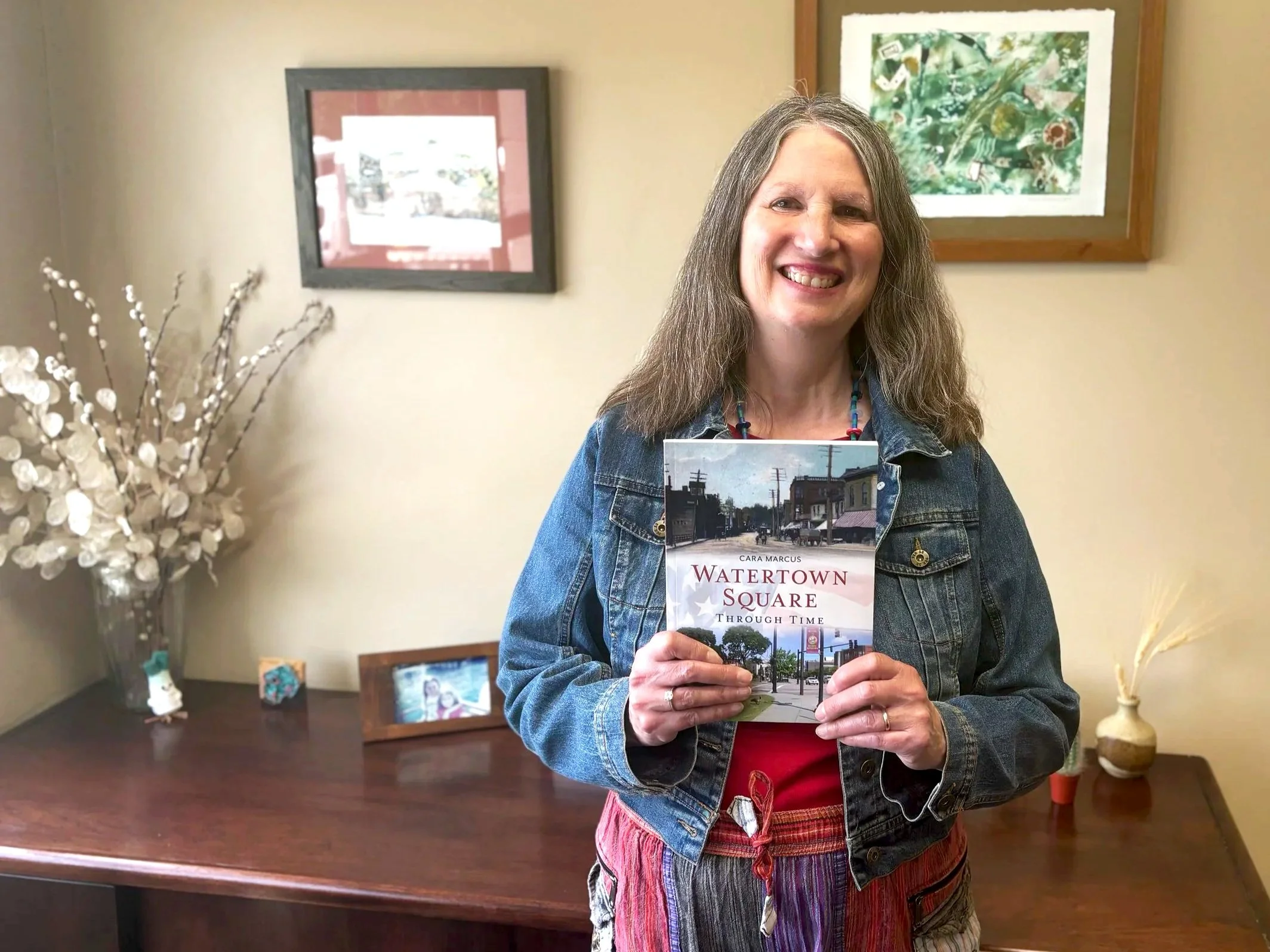
A longtime Watertown resident shares the places, stories, and everyday journeys that connect her to the city.
Who Is Cara Marcus
Cara Marcus has called Watertown home since her mid-20s—and she has been exploring, creating, and connecting with the community ever since. She is the author of Watertown Square Through Time and works as the Knowledge and Resource Manager for the National Rural Transit Assistance Program (National RTAP) in Woburn. She also teaches through Watertown Community Education, exhibits her artwork at the Till Wave Gallery, and is active in both the Watertown Historical Society and the Watertown Art Association.
And on most weekends? “You’ll find me at the Watertown Public Library pretty much every weekend, borrowing books and attending workshops,” Cara says.
How Watertown Square Through Time Began
Cara’s first book with Arcadia Publishing was Images of America: Faulkner Hospital, inspired by her time as Director of Library Services at what is now Brigham and Women’s Faulkner Hospital. Later, while she was consulting between roles, her publisher asked whether she would like to write another book.
When the publisher turned the question back to her—what would Cara like to write about?—Watertown immediately came to mind. The publisher explained that a general history of Watertown already existed and asked whether she could focus on one part of the community. Cara’s answer came even faster: “This only took 2 seconds of thought, and Watertown Square Through Time was born!”
A Town Full of Surprising Stories
In her book, Cara brings lesser-known pieces of local history to life. Paul Revere once lived in Watertown. The poem commonly known as “Over the River and Through the Woods” was written here, and part of the movie Patriots Day was filmed at Watertown’s former police station before it moved to Main Street. As Cara puts it, there are many more interesting historical facts waiting inside her book.
Seeing Watertown on Foot by Bike and by Bus
Cara experiences Watertown through a mix of walking, biking, transit, and driving—but walking, biking, and riding the bus allow her to enjoy the community in a special way. She walks to the library, concerts and farmers markets at Saltonstall Park, and the Charles River. When she bikes along the river, she always stops at “Turtle Central” to see whether any turtles are visible on the logs.
She has also noticed improvements for people walking, including highly visible flashing crosswalk lights that activate with the push of a button. A bus stop sits right around the corner from her home, making it easy to ride to Harvard Square and Boston while watching the neighborhoods change outside the window. “If there was transit from Watertown to my job in Woburn, believe me, I would be on it!” she says.
Getting Around Watertown Today
From Cara’s perspective, getting around Watertown has become easier with dedicated bike lanes and the newer bus stop on Galen Street in Watertown Square. Driving through the square can still require patience, however. “The planners are planning something easier for the future—and everyone is interested in what that will be,” she says.
The Places That Keep Her Connected
The Watertown Public Library is one of the most meaningful places in Cara’s life. She borrows books, puzzles, magazines, zines, and interlibrary loan materials—and, when time allows, settles into a comfortable chair by the window to “read, read, read.” The library’s History Room is especially important to her. She says it feels like stepping into the 1800s, and its historic town books provided much of the material for Watertown Square Through Time.
Another favorite is Hatch Makerspace on Summer Street, a welcoming place where both experienced artists and curious beginners can find workshops, supplies, examples, books, and inspiration. Cara also enjoys seeing Watertown’s creative community come together at the Watertown Arts Market in the summer and Faire on the Square in the fall.
And she cannot talk about her Watertown favorites without mentioning the Deluxe Town Diner on Mount Auburn Street, “where the food and service will definitely put a smile on your face.”
Many Communities One Watertown
For Cara, Watertown feels connected because many communities help shape it. She points to the city’s Armenian and Greek communities, the Armenian Museum, and the annual Greek Festival, along with the many ways residents gather throughout the year: farmers markets and summer concerts in Saltonstall Park, Memorial Day parades on Main Street, the Watertown Eco-Fest, and quiet afternoons fishing—or watching others fish—from the dock along the Charles River.
“People are friendly and have pride in their community,” Cara says. That community spirit is woven together with a long history of local firsts, from early water-powered industry at the Grist Mill to the Watertown Tercentenary information booth created for the town’s 300th birthday in 1930, which Cara notes was the first of its kind in Massachusetts.
With Watertown’s 400th birthday approaching in 2030, Cara is already looking ahead: “You know that Watertown will be hosting a celebration to remember!”
